
Book Cover Fold Woven Labels USA
Book cover fold wraps over a garment edge — a waistband, hem, bag strap, or collar band — so both sides carry visible branding simultaneously. One label, two branded faces — with no exposed cut edges.
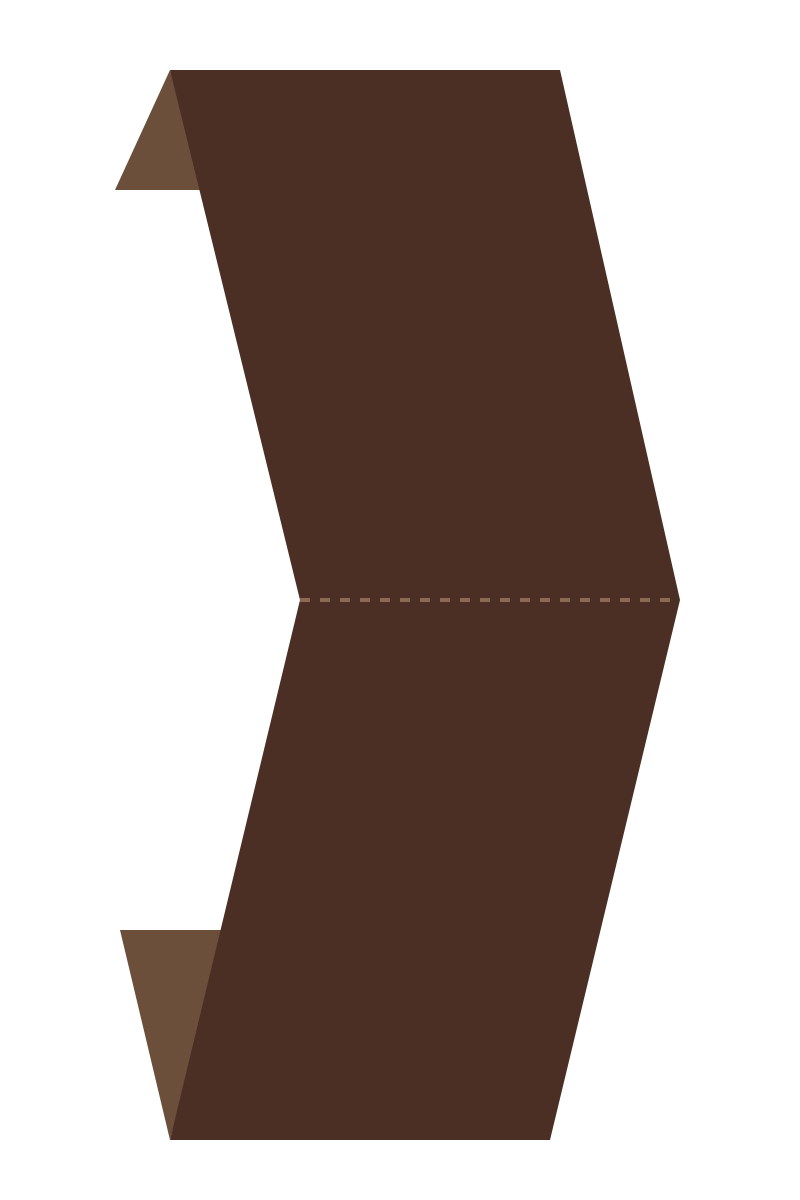
Book cover fold labels at a glance
| Construction | Wraps over a garment edge — both faces carry branding |
|---|---|
| Best placement | Waistbands, hems, bag straps, collar bands |
| Finish | Two branded faces, no exposed cut edges |
| Weave quality | Micro-HD damask, produced under OEKO-TEX® STANDARD 100 certification |
| Pricing | Instant online configurator — no quote requests |
| Try first | $1 sample kit (USA & Canada) · woven proof of your design |
Built to straddle an edge — branded on both sides
How it's constructed
- The label wraps over the edge like a book cover over a spine. The top half of the label lies flush against one face of the edge; the bottom half lies flush against the opposite face. The fold point aligns exactly with the edge.
- Stitched through both short ends. The label is secured by stitching through the upper and lower short ends. The stitch lines run horizontally across the label and hold both halves flat against the fabric face on each side.
- No exposed cut edges on any side. The fold covers the edge itself. The short ends are stitched flat. The long sides face outward, clean, with no raw fiber visible from any direction.
- Full artwork area on each face. Design the label at full flat length. The top half becomes one face; the bottom half becomes the other face. Each half is fully visible from its respective side of the edge.
Where it's used
- Waistband edges. Trousers, shorts, skirts, athletic wear — the label wraps over the waistband top edge, visible on both the exterior above the waistband and the interior facing the body.
- Hem edges on outerwear and structured garments. A book cover fold label on a jacket hem or coat hem reads cleanly from both above (exterior) and below (interior hem face) — a detail appreciated in premium production.
- Bag straps and handles. The label wraps over the strap or handle edge, visible on both the top and bottom faces of the strap. The fold point aligns with the strap edge; stitching through the short ends prevents shifting during wear.
- Collar bands on shirts and jackets. Applied to the collar band edge, the label is visible on both the interior collar face and the exterior band face — a premium collar construction detail common in tailored garments.
Artwork and sizing
Design for two faces
The label is designed at full flat length. After folding, the top half becomes the front face and the bottom half becomes the back face. You can design both halves identically, or use different content on each — brand logo on one side, size or care information on the other.
Size to the edge width
The label length should be twice the visible face height you want on each side, plus a small fold allowance. For a 1.2″ visible face on each side, specify approximately 2.6–2.8″ flat length. Width is specified independently and does not change at the fold.
Keep artwork clear of the fold line
Leave a 0.12–0.2″ clear zone at the exact center of the flat label. This is the fold point — it sits on the garment edge, not visible as a branded area. Important text and logos should sit clearly within each half, away from the center.
Damask for sharp dual-face detail
Damask construction is recommended when both faces carry distinct design content. The finer thread resolution ensures text and logos are equally legible on both the interior and exterior face at typical edge-label sizes.
Book cover fold vs other fold types
vs Center fold
- Book cover fold: Wraps over an edge. Visible on both sides. No loop standing in a seam. Used for waistbands, hem edges, collar bands.
- Center fold: Loops into a seam. Visible as a classic label in the neckline. The top fold contacts skin. The definitive neck label construction.
- Center fold is for seam insertion. Book cover fold is for edge wrapping. Two completely different installations.
vs End fold
- Book cover fold: Short ends stitched, wraps around an edge, dual-face visibility. Works on three-dimensional edges.
- End fold: Short ends folded back, lies flat on a single surface. Stitched through long edges. Single-face visibility.
- Use end fold for flat surface application. Use book cover fold when the placement is an edge and both faces need to be branded.
vs Manhattan fold
- Book cover fold: Designed for edge placement. One label, two faces. Structural wrapping construction.
- Manhattan fold: All four edges folded under. Flat patch placement on a single surface. Premium patch appearance.
- Manhattan fold lies on one surface; book cover fold straddles two. See Manhattan fold labels for premium flat-surface placement.
- The placement is a garment edge — waistband, hem, collar band, or strap
- Branding on both sides of the edge is the design intent
- A single label in a clean edge-wrapping construction is preferable to two separate labels
- Premium outerwear, tailored garments, structured bags, or athletic waistbands