
Custom Hat Patches for Caps & Beanies
Order custom woven patches for hats online: upload your logo, set the size for your cap panel or beanie cuff, and see the exact price before checkout. A 2″ cap patch is $1.56 each at 50 and $0.356 each at 1,000, with a human artwork review within 24 hours.
A cap front panel is a small, curved, seam-bounded canvas — patches for headwear need sizing and edge choices that a jacket patch does not. Woven in micro-HD damask, merrow or hot-cut edge, iron-on or plain backed, and sized to sit inside the panel rather than fight it.
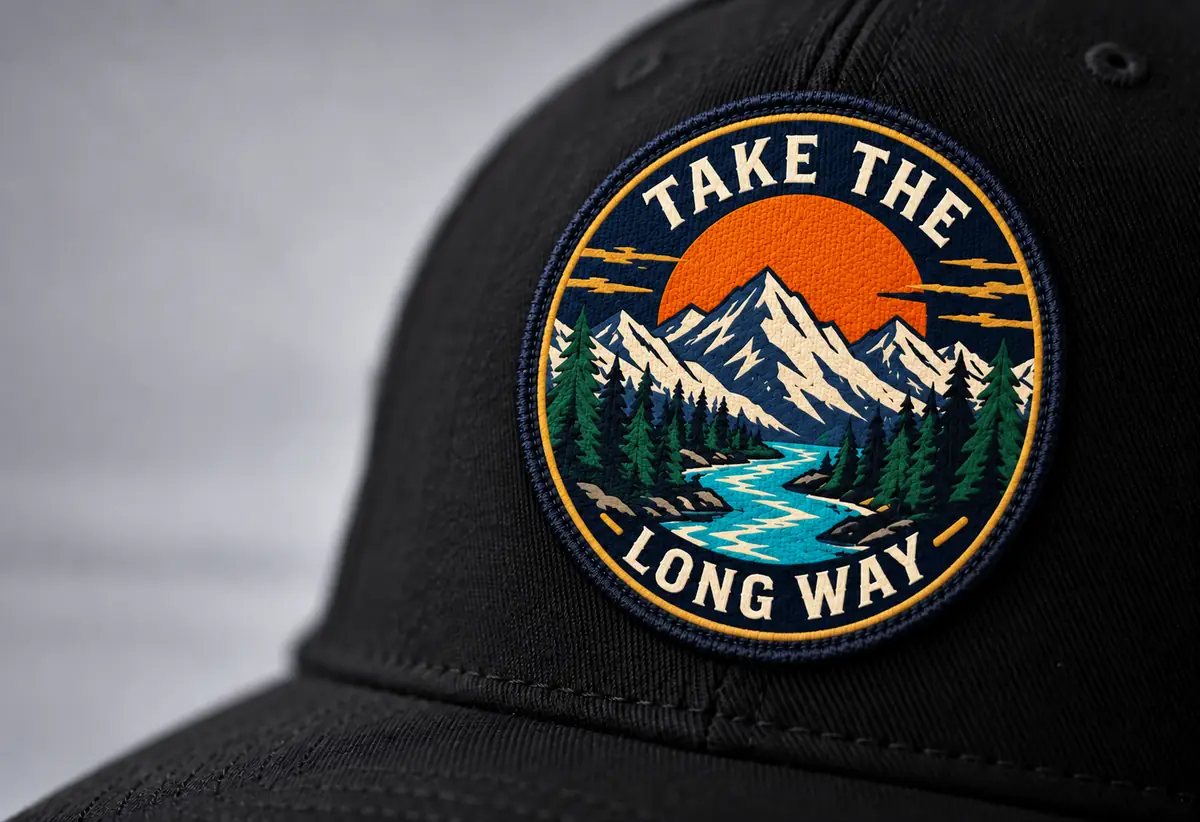
Hat patches at a glance
| Price | $78 for 50 · $356 for 1,000 (2″ patch, two colors) |
|---|---|
| Cap front panel | 2–2.6″ wide × 1.2–1.6″ tall |
| Beanie cuff | 1.6–2.2″ wide, centered on the fold |
| Edge finish | Merrow for classic caps, hot-cut for custom shapes |
| Attachment | Iron-on for structured cotton caps; sew knitted beanies |
| Minimum order | 5 pieces with a Proof Pack; standard runs from 50 — no headwear surcharge |
| Try first | $1 sample kit (USA & Canada) · woven proof of your design |
Sizing a patch for headwear
Caps and trucker hats
- Stay inside the panel seams. On a six-panel cap the front is split by a center seam and bounded by two side seams. A patch of 2–2.6″ wide by 1.2–1.6″ tall sits comfortably within that area on an adult cap.
- Leave clearance above the brim. Around 0.4″ between the bottom edge of the patch and the brim stitching keeps the patch from looking like it is sliding off.
- Wider reads better than taller. A landscape patch follows the natural shape of the panel. Tall patches crowd the crown seam and distort as the panel curves.
Beanies and knitted hats
- Go smaller — 1.6–2.2″ wide. The cuff is the only stable, double-thickness area on a beanie, and it is narrow. A large patch overwhelms it and rolls with the fold.
- Center it on the cuff. Position on the folded band, centered to the front. Placing a patch above the cuff puts it on single-thickness stretch knit, where it will pucker.
- Always sew, never iron. Knit stretches, patches do not. An adhesive bond on a beanie lifts at the corners within a few wears.
Edge finish and attachment for hats
Merrow edge — the classic cap look
The raised overlocked border gives a defined, slightly three-dimensional outline that holds its shape on a curved crown. It is the finish most streetwear, outdoor and heritage brands pick for headwear.
Merrow suits rectangles, squares, circles and ovals. Complex outlines cannot be overlocked cleanly — see merrow edge vs hot-cut.
Hot-cut — for shapes that aren't rectangles
A sealed, flush edge that follows any outline precisely, so it is the right choice for shield shapes, script logos, mountains, animals — anything that is not a simple geometric form.
It sits flatter than merrow, which some brands prefer on unstructured and dad caps where a raised border can look bulky.
Iron-on or sewn?
Structured cotton and cotton-blend caps with a stiff buckram front take an iron-on patch well — the panel is flat and firm enough to press evenly.
Beanies, unstructured caps in soft fabric, and any nylon, performance or water-repellent cap should be sewn. So should anything going through a wash-heavy life.
Colors and detail on a small patch
At 2–2.6″ wide there is less room than a jacket patch, so fine detail matters. Micro-HD weaving holds small text and thin strokes that standard looms lose, but there are limits.
Check your artwork against the minimum line thickness guide before ordering — it is the most common cause of a proof that disappoints. Most cap patches are brand marks, so see logo patches for how a logo reproduces in thread.
Who orders hat patches
Common uses
- Streetwear and skate labels branding six-panel and trucker caps
- Outdoor and hiking brands on beanies and earflap hats
- Breweries, coffee roasters and venues doing merchandise runs
- Teams, clubs and events where 50 pieces is the whole order
- Hat brands ordering a full line — see wholesale hat patches for 250–2,000+ pricing
Why woven rather than embroidered
- Holds far finer detail — small text stays legible at cap scale
- Flat, low-profile finish that does not add bulk to the panel
- Extra thread colors add far less to the price than extra stitches add to embroidery
- Consistent piece to piece across the run and across reorders
- Measure the flat area of your cap panel, not the cap itself
- Keep roughly 0.4″ clearance above the brim stitching
- Pick merrow for simple shapes, hot-cut for everything else
- Choose sewn attachment for beanies and technical caps